Bhagavad Gita for Kids: Where to Begin
The Gita can feel vast for a child. Here is a gentle, age-appropriate way to introduce its timeless wisdom, and why it matters more than ever.
Ask most adults about the Bhagavad Gita and they picture something formidable, seven hundred verses of philosophy, the kind of text one turns to in middle age when life has grown complicated. It seems, at first glance, an unlikely thing to hand to a seven-year-old. And if we tried to hand it over whole, it would be.
But the Gita was never meant to be swallowed in one piece, and it was certainly not written only for the old. At its heart it is a conversation between a young man who has lost his nerve and a friend who helps him find it again. That is something a child understands instinctively, because every child knows what it feels like to be afraid to do a hard thing.
The question, then, is not whether to introduce the Gita to a child, but how. Approached gently, in the right order and in the right spirit, it becomes one of the most practical gifts you can give a growing person, a small toolkit for handling fear, effort, disappointment and doing the right thing. Here is where to begin.
Begin with the story, not the philosophy
A child meets ideas through people and feelings long before abstractions. So the doorway into the Gita is the scene itself. Two great armies face each other across a field. Arjuna, the finest archer of his age, asks his charioteer to drive him into the middle so he can see who he must fight. And there, looking at the faces of cousins, teachers and elders on the other side, this mighty warrior simply loses heart. His hands shake. He sits down in his chariot and says he cannot do it.
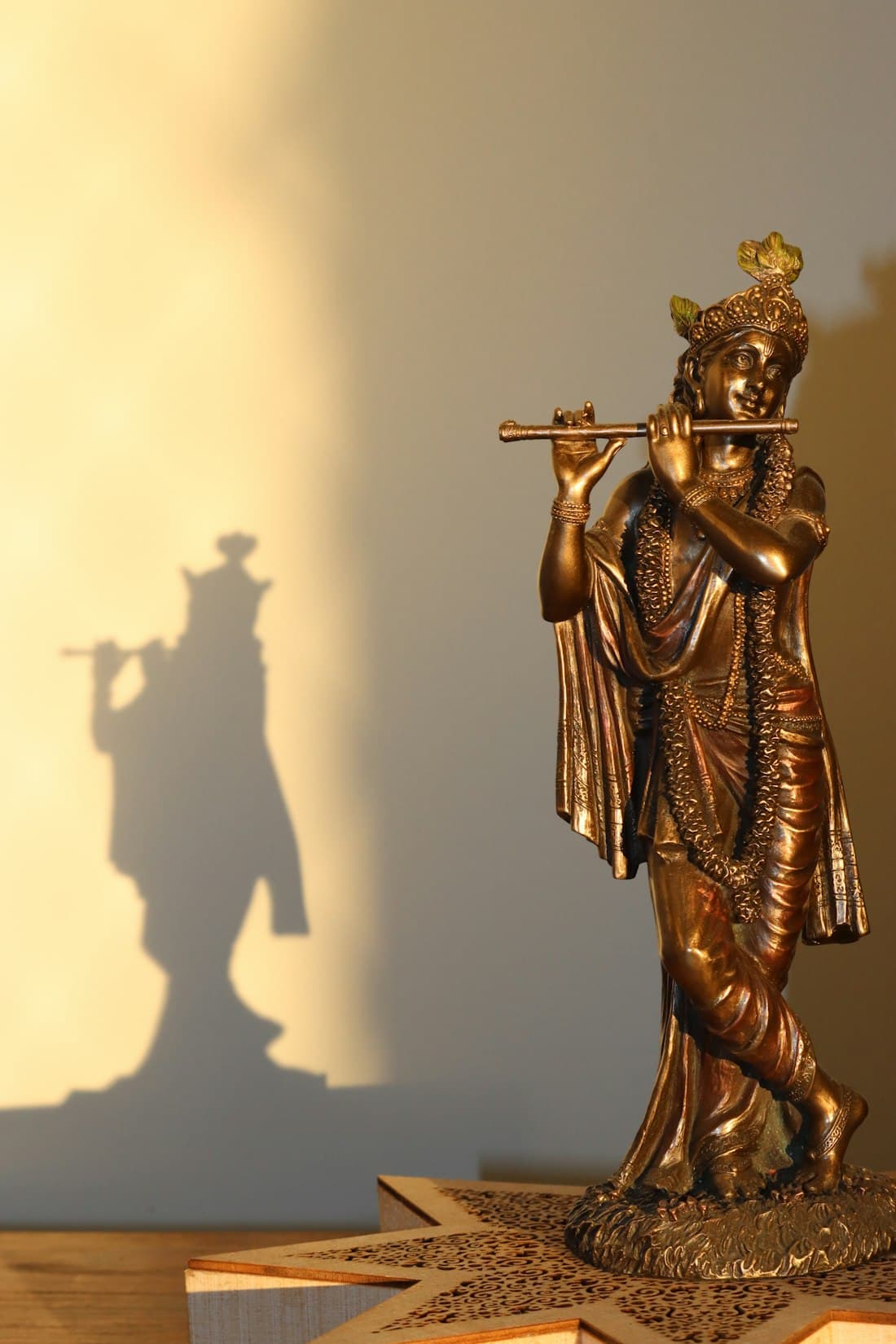
That charioteer is Krishna, and what follows is the Gita, Krishna gently talking his friend back to his feet. Told this way, a child is immediately gripped, because the feeling at the centre of the story is one they know well: the moment before a test, a match or a performance when your courage suddenly deserts you. You do not need a single technical term to make the Gita come alive. You need only the picture of a hero who is afraid, and a wise friend who does not scold him for it.
Choose a few living lessons, not the whole text
The Gita is vast, and trying to cover all of it with a child is the surest way to lose them. Far better to choose two or three ideas that a child can actually use this week, and to let those settle before adding more. A handful of well-understood lessons will shape a childhood; a hundred half-heard ones will not.
The most useful place to start is Krishna’s famous teaching about effort and outcome: do your work as well as you truly can, and then let go of the result, because the result was never fully in your hands. For a child anxious about marks, medals or being picked for a team, this is quietly liberating. It moves the focus to the one thing they control, their honest effort, and lifts the crushing weight of the score.
कर्मण्येवाधिकारस्ते मा फलेषु कदाचन, “You have a right to your effort, never to its fruits.” In plainer words: do your best, and let go of the rest.
Turn each idea into something they can feel
Abstract virtue slides off a child; a concrete moment sticks. So attach each lesson to something in their own life. When you talk about effort over outcome, tie it to the maths test they were dreading or the race they did not win. When you talk about staying steady, recall the time they lost their temper over a game and how it felt afterwards.
The Gita speaks about the person who keeps an even mind in success and failure, in praise and criticism. You can make this real by noticing it aloud when it happens: “You didn’t win, but you shook hands and meant it, that is exactly the steadiness Krishna talks about.” Named in the moment, a value stops being a lecture and becomes a description of who your child already is capable of being.
Let questions lead the way
Children are natural philosophers, and the Gita rewards their questions rather than shutting them down. When your child asks why Arjuna was so afraid, or whether it was really right to fight his own family, resist the urge to give a tidy final answer. Ask them back: what would you have done? What do you think Krishna meant?
This is not evasion, it is the method. The Gita itself is a dialogue, an argument worked through by questions, and a child who is invited to think alongside it learns something more valuable than any single verse: that wisdom is something you reason your way towards, not something you are simply handed. A little discussion after each story does far more than a memorised summary.
Keep it gentle, keep it joyful
Above all, do not rush. There is no prize for finishing the Gita, and every reason not to. One idea a week, wrapped in a story and a short conversation, is more than enough. If your child is tired or restless, stop, the Gita will keep, and a child who associates it with warmth will return to it willingly for the rest of their life.
Watch the tone, too. The Gita is not a rulebook of things a child is failing to do; it is an encouraging voice that says you are capable of more than your fear suggests. Kept in that spirit, it becomes a source of confidence rather than pressure, a friend a child can carry into every difficult moment ahead.
This gentle, story-first, question-led approach is exactly how our live Bhagavad Gita classes for children are built. We move slowly, one living idea at a time, and we make room for every child’s questions. If you would like your child to meet the Gita not as a daunting text but as a wise and patient friend, come and talk to us about our Gita classes.
Learn this with a mentor
Bring this to life for your child with our live, mentor-led Bhagavad Gita for Kids.